






Microwavable heating pads with organic fillers are a wonderful way to soothe sore muscles or just warm up on a cold day. Their combination of toasty warmth and good smell are a natural remedy you can enjoy every day without side effects. The rice-filled warming pad project we did here at Sew4Home is one of the most popular gift items ever featured. Most likely, it’s because they’re not only functional, they’re also really easy to make. Everybody who makes them seems to have a favorite filler. So we thought we’d do a little testing to see if we could find out which one is best.
Cotton on the outside, but what should go inside?
You can use other substrates, our original pad project featured fleece and cotton ticking, but the traditional choice for anything microwaveable is 100% cotton. It can get very warm without melting and has a nice feel against your skin. Of course, like anything you put in the microwave, even cotton will eventually burn if you cook it too long. The benefit to using the organic fillers is they require very little time to heat thoroughly, fifteen to thirty seconds is usually plenty.
But what about the filler? What should you put inside your heating pad to get the best results?
First of all, you want your filler material to be microwaveable; that eliminates anything with a metallic component, which will spark. It should stay warm for an extended period of time. It should have a nice smell or no odor when heated. And finally, it should have a nice feel against your skin. This last reason is probably why neck warmers filled with driveway gravel never caught on.
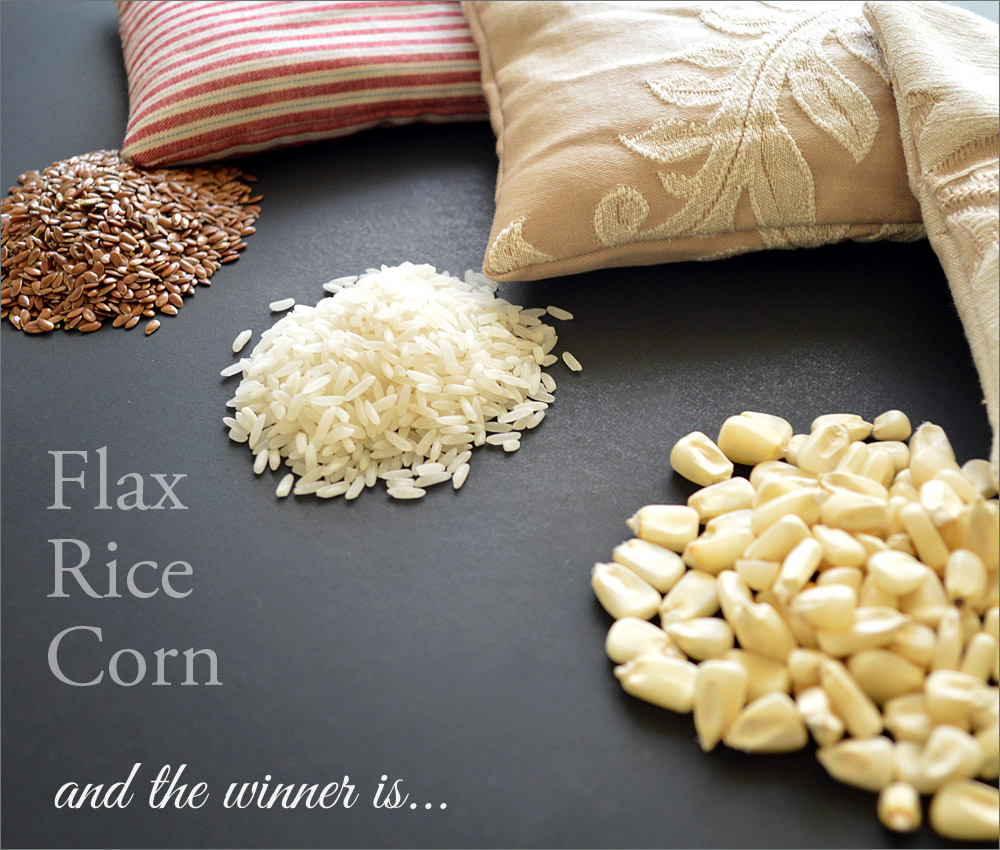
Talking with our Sew4Home team and then looking at what’s recommended on the web, we found a huge number of different fillers people have tried. The more exotic range from silica beads to cherry pits. But the ones that appear to be the most popular (and in our experience the most practical) are: rice, dried corn, and flaxseed.
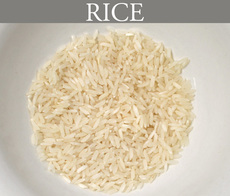
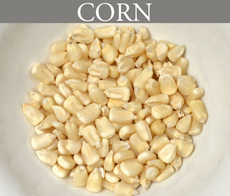
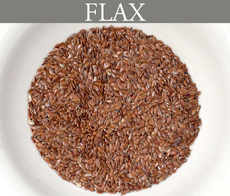
All three meet the requirements of retaining heat, having a pleasant smell, and feeling good against your skin. Additionally, we like the fact you can buy any of these rather inexpensively in the bulk food section at most supermarkets. If you’re making more than a few heating pads, this is something to consider.
Some people swear by the convenience and/or cost of buying feed or seed corn at a local feed store, but there were also many concerns about “buggies” showing up in corn. We chose to use food grade fillers for all our tests and have not experienced any issues with pests – even in pads that have been used over and over for years.
We wanted to know which of our three finalists – rice, dried corn, and flaxseed – would perform best in a “highly scientific test.”
Which heating pad filler is best? Our scientific analysis.
To test our fillers we made three 5½” x 5½” test pads from scrap cotton fabric and filled each with 1½ cups of the various fillers.
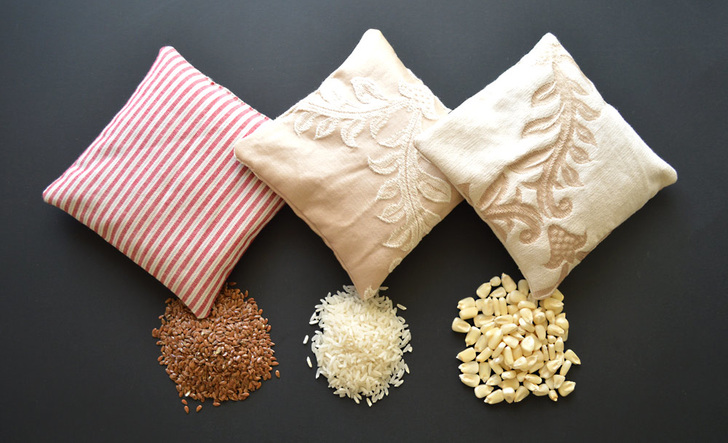
We chose to compare them by volume rather than weight because that’s the limitation on your sewn warming pad.
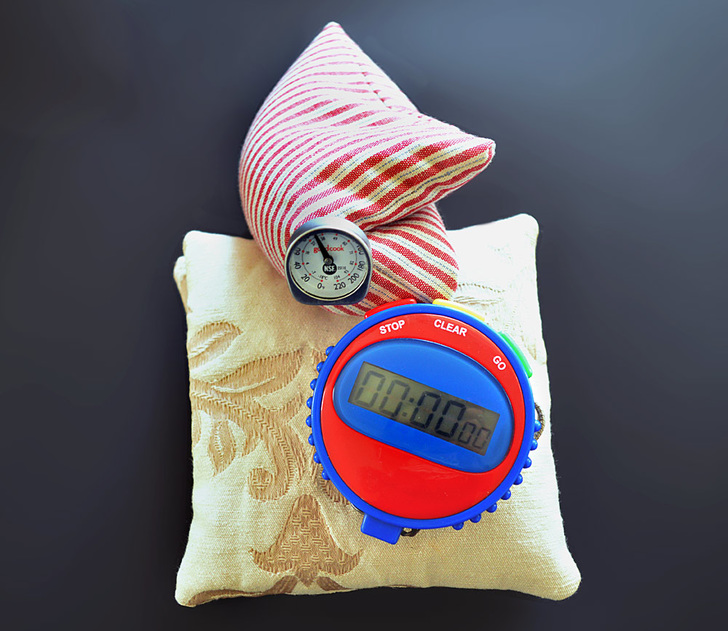
Heat retention
Using a 1.65 kilowatt microwave, we heated each of the pads for thirty seconds. Using a food thermometer, we measured how warm the pad was right when we took it out. And then how warm it was after sitting out for five minutes.
As a reference, we heated a cup of water to 140° and found it had cooled to 124° in five minutes.
Rice: 140° out of the microwave. Five minutes later had cooled to 136°.
Dried Corn: 158° out of the microwave. Five minutes later had cooled to 142°.
Flaxseed: 144° out of the microwave. Five minutes later had cooled to 142°. This one retained the most amount of heat.
One additional plug for rice, which came in second: rice is hygroscopic, meaning it absorbs water and then releases it when it is heated. You may have put a little rice into a salt shaker to absorb the water that can invade – especially in humid climates – so the salt will shake more freely. When you use rice in your heat packs it delivers moist heat, which can be quite beneficial. Putting a small cup or bowl of water into the microwave when using any of fillers inside the heating pads can help with moisture.
Smell
We’d heard some people complain that grains, like the rice and corn, can have a cooked smell when heated. We didn’t detect any strong smell. But cooking odors may be caused when the grains are microwaved too long and burn a little.
Flaxseed is a seed and so much less prone to cook. However, of the three, the flaxseed actually had the most noticeable smell.
We often use essential oils to add a pleasant scent to our warming pads. The organic fillers tend to absorb and retain these oils, but remember that a little bit goes a long way. You need just a few drops to create a lasting aroma. Other scent options include, dried herbs, flowers, and teas.
Feel
This is the most subjective test. It really depends on the texture you like on your skin.
Rice: This has a nice “full” feel, almost like a batting fiber.
Dried Corn: It has a granular, pebble feel that’s pleasant when resting on your arm or neck.
Flaxseed: This flowed the most easily and conformed to where you laid it.
Cost
As mentioned above, we narrowed it down to our three finalists because they were readily available from the majority of supermarkets with bulk bins. Prices, of course, will vary based on your area and shopping options. The costs shown below are averages.
Rice: $1.15 per pound
Dried Corn: $1.30 per pound
Flaxseed: $2.99 per pound
Conclusion
If you’re going solely for heat retention, use flaxseed. But all three of the fillers we tested performed better than water and so should stay warm longer than a traditional hot water bottle.
For smell and feel, we found things to like about all three. So much so, that we’ve even mixed rice and flax for some of our projects.
We now expect the major scientific journals to begin clamoring for the publishing rights to our detailed research, but you can use it for free.
Conduct your own experiment
Of course, there are many other filler options; we simply didn’t have the time to test them all. We’ve heard good anecdotal evidence for using lentils, dried soy beans, millet, birdseed, and hard wheat. Put on your white lab coat and do some testing of your own. We’d love to hear about your own successes or failures with organic fillers.
If you’re ready to put your fillers into practice, check out our projects for Rice Warming Pads, a Scented Spa Set, and a Therapy Neck Wrap. These projects also include tips on heating, cooling, and cleaning.
Would you recommend using lava sand in your heating pads?
Hi Rosa – that is not one we have experimented with. I’d recommend doing the same test as we did above: make a little prototype, fill with the lava sand, and try some heating tests to see how it retains heat and for how long.
How long does the rice stay fresh in the packs?
There are a lot of variables, like the size of the pack, the amount of usage, etc. Since you can’t launder the packs, it’s usually best to watch for when it becomes slightly smelly or dirty. Then it’s time to make a new pack.
I received a bean bag pillow as a gift. I don’t know what’s inside of it, but when I heat it in the microwave it gets very wet. Maybe damp heat is good for something, but I do not like it. I’ve even tried to dry it out by putting it in a low temperature oven several times. Did not help at all. It is several years old, so whatever is in there is never going to dry out it seems. What can I refill it with that won’t sweat when heated?
Hi Vee — that is rather unusual. I’m not sure what could be causing something to get that “wet.” As mentioned above, our favorite fillers haven’t had that type of result. Rice and a Rice/Flax Seed blend are our favorites. You might be better off making a new pad (link to our free project below) or buying a new pad. If the gift pillow didn’t come with instructions, it will be hard to figure out how to fix it.
https://sew4homestg.tnotw.com/microwavable-rice-filled-heating-pads/
I used to make and sell corn bags, I made them out of scrap ultra suede I got from a motor coach company, then my house burned and that all went away. I used the corn bags mainly for period cramps, now my feet are always cold. I use heating pads now, with them tucked at the foot of my bed under the covers, they keep breaking down on me and I’m very frustrated about that. The next one i buy will be expensive so hopefully it won’t break on me. In the mean time since I have a lot… Read more »
Hi Lisa — you deserve toasty toes!!
I’d add one more filler to consider although I don’t know the comparison on how well/long it holds it’s heat in comparison but buckwheat hulls is both therapeutic, holds heat and even better not prone to harbor microorganisms/microbacteria like many other fillers. I have a pillow with buckwheat and lavender and it helps sleep and thermo regulation too.
Call me lazy. My bag needed to be replaced and I wasn’t in the mood to buy flannel and pull out the sewing machine. I bought a pack of cotton tube socks and filled one up, tied a knot in the end and wrapped thread tight just below the knot . They work great, feel great and with the weight of the filler the sock will stretch long enough to wrap around neck. I have made some for friends and relatives and they love them. I call them Snuggle Buddies.
I’ve made loads of these for friends and family over the years. I’ve always filled mine with pearl barley
A friend of mine made a corn bag for me years ago. She added whole coffee beans with the corn and it smelled absolutely amazing! Lasted for years, also. This post has inspired me to make another one as I had forgotten how much I loved it!
Wow – what a great option. Thank you for sharing.
I came here just for this comment!! I was gifted a large bag of whole coffee beans and my family is a bunch of coffeeholics so I wanted to see if anyone has tried that yet. Just a few to each should add a nice aroma
I am interested in combining dried erbs to my relaxing & sleeping eye masks. Has anyone combined dried lavender with dried camomile blossoms to help with sleep? Or is it not good to add the 2 together?
Hi – Dried herbs can be wonderful, but with something that is heated and/or cooled numerous times over the use of an item, their wonderful scents can deteriorate rather rapidly. We prefer to use essential oils. As with all things, try a test in a small bag made of scraps to determine if you are happy with the results.
A good solution that I have found for retaining the scent much longer, is to sprinkle the pad with few drops of water before heating it 🙂
Great tip, Stevi – thanks!
yes I have rice and lavender from the garden and it smells amazing. Really relaxing!
Thank you so much for your article ,it was very helpful. I took my granddaughters warmy apart to wash it an found a bag with brown seed an lavender pieces. I was curious as to what the seeds were. I sew an crochet an I’m looking forward to making some heating pads of my own.
You’re welcome, Denise. There are SO many filler options (we just looked at three of the most common), so it’s hard to know what you found — perhaps flax seed. I’m sure your granddaughters will LOVE to have a new “warmy.”
I would love to know where you can purchase flaxseed for $.83 a pound? The cheapest I have been able to find it in Colorado is $2.99!!
Hi Patty – It looks like our latest update to this article was 2018; prices have certainly gone up since then. When we have a moment, we’ll do a bit more research locally and update the price averages.
Interested in the pricing also
Hello – It’s always best to do your price searching locally. Our quick look today found $2.95 as the lowest price for a pound.
I’m so grateful this is a discussion with so many experts! Thank you Sew4Home. Here’s my question: can rice be re-used a second time in a bag? I made a large bag that took a lot of rice a year ago. The microwave has broken down the heavy cotton upholstery fabric I used and it is leaking the rice, so a new one is in order. The grains are about 1/4 the size of the original grain and light golden brown. It was such a big bag, I hate to just throw it away. What would you all do?
Heidi – it’s up to you. I guess you could give the old rice a try in your new cover — without completely sealing it shut. Perhaps just basting it closed as a test. And see if it heats up well. All things being equal, I’d recommend going with new rice for the best results.
Is anyone willing to make & sell me 2 rice-filled bags? I’m a 72yr old retired man, I don’t sew!
yes
How much?
Yes. Would need to know where to send them.
Lincoln Nebraska
Yes sir! I’m Jennifer in California! I ahave an online shop on the ebay website :
*hsn*homeboyshopinnetwork or contact my email please!
I went to eBay couldn’t find the link you provided. I don’t know how to access your email.
I also use these packs as cold packs in the freezer for kids boo boos. Actually, I use them this way more than I fo as heating pads. I wonder which has the best cold retention.
Hi Nicole – they do work well as cold packs. We didn’t test for cold retention. If you do any tests, let us know you results.
That’s what I’m wondering
The best thing to use as a filler is buckwheat, I know this because I invented the microwave heating pillow, in the 90s, unfortunately I didn’t patent my idea, I spent years testing different types of grain, blow-up many microwave ‘s but fond buckwheat has the most therapeutic value.
Thanks for such expert input!
Can you explain why buckwheat does? I am curious why it stands above others.
The buckwheat retains heat much longer than rice or flaxseed but it is hygroscopic like rice. So it is a moist heat filler that lasts a long time. The weight and “kernel” size is pleasing. Also, doesn’t really have a smell unless you overcook it, then it smells like popcorn for a few days : P
I don’t actually make the heat packs. But I am a avid user.. I have both rice and flax heat packs but just wanted to get my opinion in. I do prefer the rice filler. I feel that after a few years of use the flax seed bags tend to burn more easily even after decreasing the time in the microwave. Not sure but it may tend to burn more easily after the first initial burn. The smell it terrible. Similar to burndt popcorn. I’ve never had a problem with rice burning even with lengthy time in the microwave.
Hi Amy – thank you so much for weighing in with your personal experience! As you can see, this is a very popular post – in part because of all the varying opinions.
Do I need to sew separate packets or pillows so the fill doesn’t all fall to one end of the bag or sock or is it not an issue if it’s full enough?
Hi Cathy – We do prefer to make smaller compartments. It makes it easier to mold the heating pads and place them just where you want it. Here is our most popular heating pad tutorial so you can see what we mean: https://sew4homestg.tnotw.com/microwavable-rice-filled-heating-pads/
Can you use Mary Jane shake as a filler?
Well, that’s an unusual one — had to look it up! With anything we haven’t tested, our suggestion is always to follow our steps above to make your own small bag as a prototype to test on your own and judge your results. In general, it seems like shake might not have the density – might be too “fluffy” – to really hold the heat. But — give it a try.
Iam getting ready to make a neck warmer and will make a filler case out of unbleached cotton, the cover will be made like an envelope pillowcase so the filler pack can be removed and the cover washed. Like your idea of half rice, half flax
Sounds like a good idea, Deb! Let us know how it turns out. Rice + flax Is one of our favorites.
Can you mix the fillers together or is it best to just do them all on there own
Hi Niki – As always, the best option is do a little test – similar to what we did above – with the mixture you’re interested in. We often use Rice mixed with Flax – especially when adding essential oil as a scent. The rice absorbs and retains the oil while the flaxseed provides a smooth, soothing texture.
Is it allowed to open the bag and remove the seeds if you want to clean the bag and put back the seeds or will this spoil the seeds?
Hi Martina – we have not tested this but it would likely depend on the type of filler. In general, it seems like a lot of work. When we make our pads, they are meant to simply be spot cleaned and then recycled when their life is up. You could make a cover that could be removed and washed – just remember to not use anything metal for that cover’s closure … no zippers or snaps that would not work in a microwave.
HI, I make removable covers for my heat pads, easy to wash. as someone above mentioned, like a pillow slip.
Yes! We offer the same slip on option for our popular Rice Heating Pads project: https://sew4homestg.tnotw.com/microwavable-rice-filled-heating-pads/
I make a pillow case for the grain bag
What about chia seed?
It’s not one of the options we tested above, and there are so many comments on this article, I honestly can’t remember if anyone has mentioned that one before. The best suggestion is to do a test similar to ours above using chia seed in a small prototype bag and see what you think about the heating ability and its retention.
Thank you for posting your “test” results. I made some of these years ago and just decided to make some again. I was looking at my recipe and wondering what my reasoning had been before I bought the ingredients again. I made mine with equal parts of rice, flaxseed, dried lavender, dried oak moss, but no essential oils. The ones we are currently using are at least five years old, maybe closer to 10 and they still smell faintly lavender, definitely pleasant. I have used spearmint and chamomile in the past as well although both of those fade faster than… Read more »
Thanks, Cindy — it’s super helpful to get your first hand experience with pads that have worked well for so long!
Has anyone ever used Groats or oat berries? My Magic Bag has oats in it by they still have the hulls on them.
Hello Jackie – we have not tested either option you describe. As you can see, there are a lot of comments on this particular article. You’d need to scroll through to find any mentions of oat berries. As always, as described above, you could make a small prototype test bag to try out and test your filler idea.
I used buckwheat groats for my brother’s heating pad. He was using it everyday multiple times a day for about 4 months. It caught fire last week. I do not think I’d use groats again.
I have a ton of bird seed that I am no longer going to use to feed the outdoor birds. Has anyone tried it before? One of the bags has some unshelled sunflower seeds mixed in as well.
Hi Michele – that is one we haven’t tested. You could certainly make a little prototype bag as we did above to test it. I just don’t know how seeds would hold up to repeated heating. They can sometimes be a bit delicate.